Wednesday, November 16, 2011

Chefcaouen, Morocco


Last weekend, we took the ferry from Spain to Tangier, 
and drove with a guide to Chefcaouen, Morocco.
We fell in love with this place...

Mustafa was our personal driver/guide. For the 3-hour 
trip from Tangier to Chefcaouen, we spoke openly with Mustafa 
about Islam, women's rights, the sheep sacrifice that took place 
the weekend before, and politics. He was proud that Morocco was so 
progressive. Jews, Muslims, and Christians live side by side here 
without conflict. Women can drive, work for the same wages 
as men, and also have the right to seek divorce. The time we 
spent learning about his country was a highlight of the weekend. 
Nestled in the Rif mountains, Chefcaouen is painted 
in shades of beautiful blue.

According to Mustafa, people with money have moved
 out of the town. Those that remain are poor.
We thought we'd see mainly older people, but we saw plenty of

 children playing in the streets (it was a Saturday).
This is one of our favorite photos. 
Chefcaouen is about color, texture and imperfection. 

Locals did not want their pictures taken. 
We respected their wishes, of course (or tried to...) 
But it was so tempting to photograph the people we saw: 
Berber women with traditional garb, country women 
with big straw hats, men in long djellabas, women in scarves, 
and a few in full blue burkas. 
So different and exotic. 

We couldn't resist...

Children taking home bread (hidden under the cloth).

Local women do their laundry in this river that runs 
through Chefcaouen.We saw women washing their clothes, 
then hanging them on trees to dry.

Pigment for paint colors inside and outside the home.

We had a phenomenal lunch at Casa Hassan. This was Deb's 
bowl of couscous, almonds,currants and chicken.
 Food, overall, in Morocco was delicious.
We never had a bad (or even mediocre) meal.
Most of Morocco is dry, but they sure like their Cokes!

In Chefcaouen, Mustafa handed us over to an able local guide.
Abu Salam was a spry 72. He took us around the town 

and into the mountains.
 He seemed to know everyone, and in his care, no one ever 

bothered or hassled us.
 (He gave us permission to take this photo). 

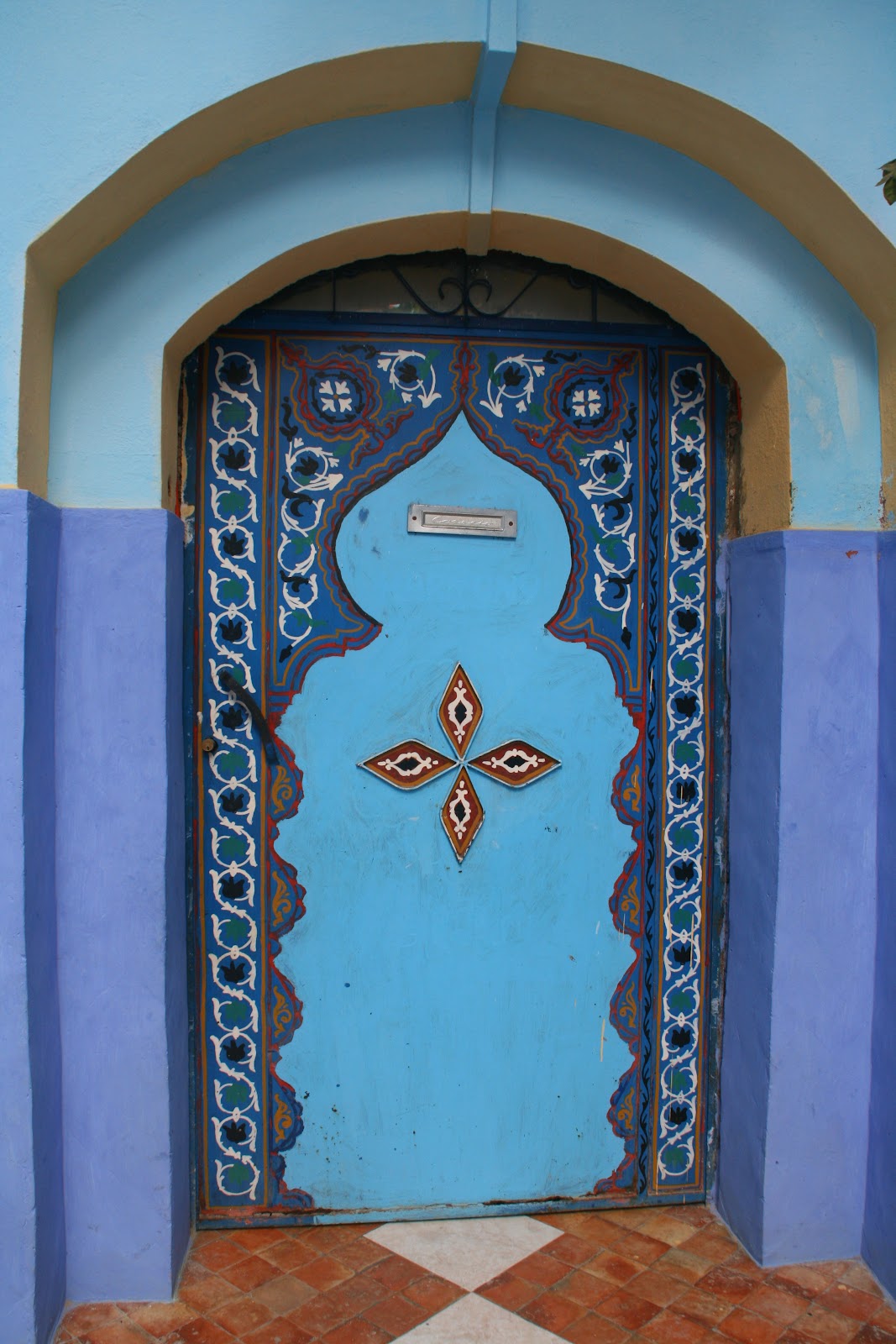
We could have done an entire photo essay 
on the doors in this town. 
This one was just one of the beauties.
Pottery was aplenty. These are a few of the pieces 
we bought (in Tangier).
All hand painted in Fes (Fez). 

Another irresistible blue view. We took 
hundreds of photos.
 It was hard to pick just a few.

The Hat Man store is famous here for, you guessed it, hats.


Another shot in blue.

We love our door knockers. We've photographed 
many in Spain, and found a few goodies in Morocco.

At the end of the day, we drove back to Tangier 
and didn't say much in the car. 
When you get bombarded by so much that is exotic and new, 
you need to quietly sit with it for awhile. 
Winding through the mountains, we passed 
men plowing fields with their mules, 
others drinking sweet mint tea in dilapidated bars,
 and locals selling huge bags of onions along the roadside. 
This kind of foreign travel leaves you feeling
 exhausted and exhilarated at the same time. 
It was a terrific weekend.


(Fez in February, here we come....:)

Thursday, October 27, 2011

Basque Country and Rioja

Over Labor Day Weekend, we traveled to the Basque Country in northern Spain.
What a different world than our southern Andalucia.
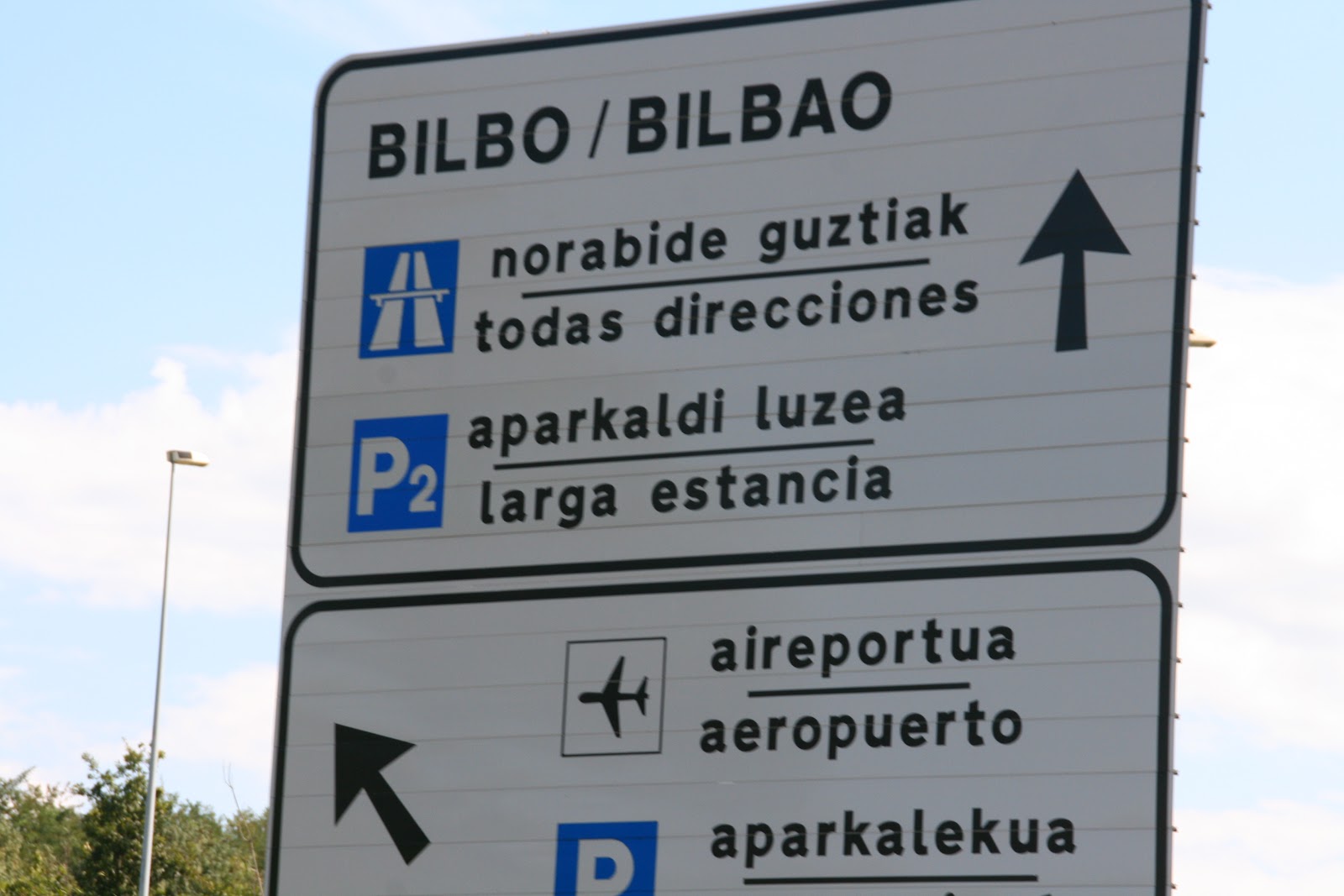
First, check out the language. Lots of z's and k's---more Greek than Spanish.
The Basque language is unique.

The Guggenheim Museum is the main draw in Bilbao, the major center of Basque Country.
 Since 1997, this museum has changed this previously industrial city into a major cultural center in the North.
The architecture of the museum far surpassed
 the interior exhibits, in our opinion. Cool spider, right?

Guarding the Guggenheim is this puppy made of flowers. Well watered and weeded. 

Although it is in Spain, Bilbao has the feel of a northern European city.


Next stop on our driving tour: Guernica. The Peace Museum is on the left. What a gem.
During the Spanish Civil War (1937) German planes bombed and obliterated this sleepy town, 

with Franco's permission. The bombing has often been considered one of the first raids in the history of 
modern military aviation on a defenseless civilian population.
 Instead of seething in resentment, the people of Guernica created this wonderful little
museum that celebrates peace and freedom for all oppressed people.


On the road  leaving Guernica. This does not look like the Spain
 we know. It's more like an Irish landscape.


The Basque coast is magnificent. 


Lekeitio: A fishing port on the Basque coast between Bilbao and
our destination of San Sebastian

Working fishing boats. Who knows what this says, but it's another example
of how un-Spanish the language seems.


Leaving Lekeitio, we found ourselves driving through the mountains in the middle
 of a professional  bicycle race for numerous miles.
We looked like one of the "support cars." (It caused a little stress!)

We arrived at our hotel in San Sebastian. This is the view of the Bay of
Biscay from our hotel room.

A view of San Sebastian's harbor (not the best picture) from our hotel .
A major resort town in the Basque Country, this place is for the wealthy.
The food was most cosmopolitan. What a wonderful surprise!

Next stop:  Rioja, the wine country, about 2
 hours south of San Sebastian.


Rioja is home to red wine production in Spain.


Our hotel was part of a winery. We had a private tour of the wine cellars and
private dining rooms below the Inn.  (Monges, 2000; excellent wine).

What we learned....

On our visit to the Basque Country, we realized how vast and varied Spain is. The language,
history, people, food, and culture of the area are so different than what we know in Andalucia.
There has been a long-standing desire for greater regional autonomy in the North, and having seen
the area with its own uniqueness, we can better appreciate their internal conflict.

Wednesday, August 24, 2011

Sunday Night at the Bullfights


When in Spain, do as the Spaniards do. So Sunday evening
we went to the bullfights in El Puerto.

There are two windows to buy tickets: "Sombra" (shade) or "Sol" (sun).
Your choice is sitting on the shady or sunny side of the ring, and tickets are
priced accordingly.  

Everywhere you looked in the stands, fans were flicking.

The bullfight begins with a procession of the main players:
Matadors in front, followed by banderillos with hot pink capes,
and picadores mounted on horseback. Music by a 20-piece brass
band accompany the hoopla.


Each of the six bullfights are introduced by an hombre holding a sign,
 indicating where the bull was bred, the bull's date of birth
and weight, as well as the name of the matador.
 Each bull is at least 4 years old and weighs up to 600 kilos.
The bull is released into the ring. 

The banderillos, with their hot pink capes, take turns taunting the toro,
 attempting to tire him out.

Next, the picadores arrive on heavily padded and blindfolded horses.
When the bull charges the horse, the picadore lances the bull's neck,
causing the bull to lose blood and weaken.
In the next stage, three banderillos each take turns thrusting two
barbed sticks (banderillas) in-between the bull's
shoulders, which further enrages the bull.


After taunting the bull, the banderillos move to safety behind
 wood shields located around the bullring. (Wimps)
Then the matador takes center stage with his red cape. Surprisingly,
bulls are color blind; they attack moving objects. The red conceals the blood.

The matador does a number of passes. With each pass, the
audience shouts "ole!"

Within 15 minutes of the first pass, the matador prepares
for estocada (thrusting the sword for the kill)


 If estocada is not successful, the matador must then perform a descabello 
and cut the bull's spinal cord with a second sword called verdugo, to kill it instantly 
and spare the animal more pain, which is what you're seeing here.

At the end, a team of horses drags the bull's body out of the ring to
the sound of cracking whips.
 (Think about a scene from Ben Hur... minus the chariot)


So what did you do Sunday night?


Monday, August 15, 2011

Daytrip to Zahara and Grazalema


Zahara. When we arrived it was a little hazy. We climbed up
to the castillo you see on the very top.

Views were amazing. The water in the reservoir was a
teal color, like you'd see in the Caribbean.

Pretty church in Zahara. See the sky? That's typical. No clouds. Very blue.
 Lots of sun. It hasn't rained a drop since Easter.

Grazalema. Another picturesque pueblo blanco.
We bought a couple of rugs made here.

This was an unusual door knocker b/c it  looked like a
man's hand, and it was a right hand. The "limp hand" door knocker is typical of Spain but
usually it's a woman's left hand. Wonder why the difference here?
Fabulous drive to and from Grazalema.

More landscape. Most roads are in great shape in southern Spain. I love driving b/c there is so
little traffic (maybe b/c gas is so expensive at more than $7 a gallon!?) 

Last stop was the Cueva de la Pileta about 40 minutes from Grazalema.
This privately owned cave had literally  hundreds of prehistoric
 drawings, 20-30,000 years old.
We made our way with kerosene lanterns.
The owner takes no more than 25 people at a time. In our group, we had a French family,
Spanish folks, and Jim and I, the lone Americanos.
On our way home, we went through a little town and saw this curious sight:
An hombre obviously had ridden his horse into town,
 hitched him up, and sat down for a cerveza.  Gotta love rural Spain!